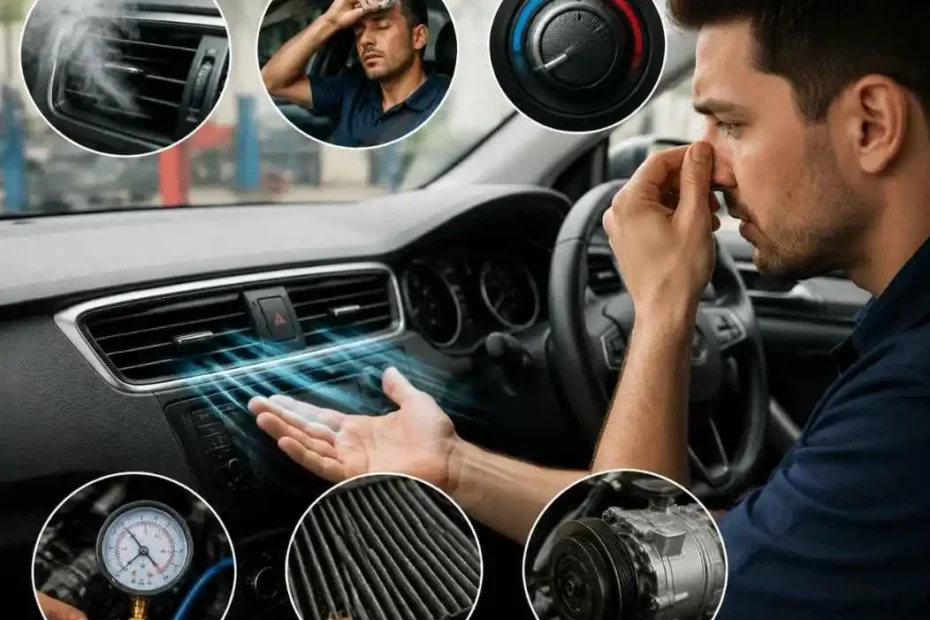
A properly working car AC is essential for a comfortable drive, especially during hot summer days. But when the cooling starts becoming weaker, unusual sounds appear, or an unpleasant smell comes from the vents, your vehicle may need car AC repair.
Many AC problems do not happen suddenly. Instead, the system often gives small warning signs before a component develops a major fault. Recognizing these signs early can help you get the right inspection at the right time and avoid unnecessary repair expenses.
In this guide, we’ll discuss the most common signs that indicate your car AC needs attention and when you should consider professional car AC repair.
Why Should You Pay Attention to Car AC Problems?
A vehicle’s air conditioning system depends on several components working together, including the compressor, condenser, evaporator, blower motor, refrigerant lines, filters, sensors, and electrical parts.
When one component starts developing a problem, it can affect the overall performance of the system. For instance, a restricted filter can reduce airflow, while a refrigerant-related issue may result in poor cooling.
Ignoring these changes can sometimes allow a small fault to develop into a more complicated repair. Getting the system inspected when you first notice a problem is therefore a sensible approach.
1. The AC Is Not Cooling Properly
Reduced cooling is one of the most noticeable signs that your vehicle’s AC system needs attention.
If the air coming from the vents is no longer as cool as it used to be, or the cabin takes much longer to become comfortable, there could be several possible causes. Refrigerant-related problems, restricted airflow, a dirty condenser, compressor issues, or other system faults may affect cooling performance.
Poor cooling does not automatically mean that the compressor needs to be replaced. A proper inspection can help identify the actual cause before any major repair is carried out.
2. Airflow From the Vents Feels Weak
Sometimes the air coming from the vents feels cool, but the airflow itself is very weak.
This can happen because of a clogged cabin air filter, blower motor problems, blocked air passages, or other ventilation-related issues. Dust and debris can accumulate in the filter over time, especially if the vehicle is regularly driven in dusty or heavily polluted areas.
If increasing the fan speed does not noticeably improve airflow, the ventilation system should be checked.
3. The AC Takes Too Long to Cool the Cabin
Another common warning sign is when the AC still produces cool air but takes much longer than usual to cool the interior.
A number of factors can affect cooling efficiency, including restricted airflow, condenser condition, refrigerant-related issues, or problems with other AC components.
If you notice a clear difference in how quickly your vehicle cools compared with normal use, it is better to have the system inspected instead of waiting for the cooling to disappear completely.
4. An Unpleasant Smell Comes From the AC Vents
A strange or unpleasant odour when the AC is switched on should not be ignored.
Moisture can accumulate within parts of the AC system, while dirt and other contaminants can contribute to unpleasant smells. A dirty cabin air filter can also affect the quality of air entering the vehicle.
If the smell returns every time you turn on the AC, the filter and ventilation system may require cleaning or inspection. In some cases, professional AC cleaning may also be necessary.
5. You Hear Strange Sounds When the AC Is Running
Your car’s AC should generally operate without loud or unusual noises.
Grinding, rattling, clicking, squealing, or other unfamiliar sounds may indicate a mechanical or electrical issue. Depending on the sound and when it occurs, the problem could involve the compressor, blower motor, belt, fan, or another component.
If a new noise appears whenever you switch on the AC, getting it checked early can help prevent further damage.
6. The AC Keeps Turning On and Off
If the AC compressor appears to switch on and off more frequently than normal, there may be an issue with the system.
Frequent cycling can be associated with refrigerant-related conditions, sensors, pressure-related problems, or electrical faults. The exact cause depends on the vehicle and its AC system.
Rather than assuming that the behavior is normal, have the system inspected if the cycling is noticeably different from before.
7. You Notice Unusual Fluid or Leakage
A small amount of clear water under your vehicle after using the AC can be normal. It is generally the result of condensation produced during the cooling process.
However, unusual fluid, oily residue, or signs of leakage around AC components should be inspected.
If you notice something that does not look like ordinary condensation, avoid assuming that it is harmless. An inspection can help determine whether the issue is related to the AC system or another part of the vehicle.
8. The AC Works Only Sometimes
Does your AC cool properly on some occasions but perform poorly on others?
Intermittent cooling can have several causes, including electrical faults, sensor issues, compressor-related problems, or refrigerant-related conditions.
If switching the AC off and on temporarily restores its performance, that does not necessarily mean the problem has been fixed. The underlying issue may still be present and should be diagnosed properly.
9. The AC Controls or Indicator Behave Abnormally
Modern vehicles often use electronic controls and sensors to manage the AC system.
If the AC button, indicator light, temperature controls, or climate-control display behaves differently than usual, it may indicate an electrical or control-related issue.
Flickering indicators, controls that fail to respond, or settings that behave unexpectedly should be checked, particularly when these symptoms occur along with reduced cooling.
10. The Windshield Does Not Defog Properly
Your vehicle’s climate-control system can also help manage moisture on the windshield when the appropriate defogging or defrost setting is used.
If the windshield takes longer than usual to clear or the climate-control system does not respond correctly, the ventilation and AC system may require inspection.
Good visibility is essential while driving, so issues affecting windshield defogging should not be overlooked.
Can Low Refrigerant Cause Poor AC Cooling?
Low refrigerant can be one possible reason for poor cooling, but it should not automatically be assumed to be the problem.
If the refrigerant level is low, there may be a leak or another issue that needs to be identified. Simply adding refrigerant without finding the reason for the loss may only provide a temporary improvement.
This is why professional diagnosis is important when your vehicle’s AC is not cooling as it normally should.
When Should You Consider Car AC Repair?
You do not have to wait until the AC completely stops working before getting it checked.
Consider professional car AC repair when you notice the following:
- Reduced cooling performance
- Weak airflow from the vents
- Unusual AC noises
- Persistent unpleasant smells
- Frequent compressor cycling
- Intermittent cooling
- Unusual fluid or leakage
- Problems with AC controls or indicators
- Difficulty clearing windshield moisture
Early inspection can make it easier to identify the source of the problem before it affects other components.
How Can Regular AC Maintenance Help?
Regular maintenance can help identify developing problems and keep the AC system working efficiently.
Depending on the vehicle and its condition, an AC inspection may include checking cooling performance, airflow, filters, visible leakage, electrical components, and other important parts of the system.
Keeping the cabin air filter clean and following the vehicle manufacturer’s recommended maintenance schedule can also support consistent AC performance.
Routine attention is generally more practical than waiting for a complete AC failure, particularly during the summer when the system is used frequently.
Why Choose Professional Car AC Repair?
AC problems can have different causes even when the symptoms appear similar. For example, weak cooling may be related to airflow, refrigerant conditions, a component fault, or another issue.
A professional technician can inspect the system and determine what actually needs attention instead of relying only on the visible symptom.
This helps avoid unnecessary part replacement and ensures that the repair is focused on the underlying problem.
Final Thoughts
Your car’s AC system usually provides warning signs before a small issue turns into a bigger problem. Reduced cooling, weak airflow, unpleasant smells, unusual sounds, frequent cycling, intermittent performance, and unusual leakage are all reasons to pay closer attention.
If you notice any of these symptoms, timely car AC repair can help identify the issue before it becomes more difficult or expensive to resolve.
Vishwakarma Automobiles provides professional automobile repair and AC services to help keep your vehicle comfortable and ready for everyday driving. If your car’s AC is no longer performing the way it normally does, getting the system inspected by an experienced technician can be a practical first step.
FAQs
How much does Car AC Repair cost?
The cost depends on the actual problem. A cabin filter replacement or basic service may cost less than repairs involving major components such as the compressor. A proper diagnosis is needed to determine the repair cost.
When should I take my car for AC repair?
You should consider getting the system checked when you notice reduced cooling, weak airflow, unusual smells or noises, frequent cycling, intermittent performance, or signs of leakage. Early inspection can help prevent the issue from becoming more complicated.
What are the common signs that a car needs AC repair?
Common signs include poor cooling, weak airflow, unusual smells, strange noises, frequent AC cycling, intermittent cooling, and unusual fluid or leakage around the vehicle.
Why is my car AC not cooling properly?
Poor cooling can be caused by several issues, such as refrigerant-related problems, restricted airflow, a dirty condenser, compressor issues, or other faults within the AC system. A professional inspection can identify the actual cause.
How often should a car AC be serviced?
It is generally a good idea to have the AC system inspected at least once a year, especially before the summer season. Regular checks can help identify developing problems early.
The cost depends on the actual problem. A cabin filter replacement or basic service may cost less than repairs involving major components such as the compressor. A proper diagnosis is needed to determine the repair cost.
You should consider getting the system checked when you notice reduced cooling, weak airflow, unusual smells or noises, frequent cycling, intermittent performance, or signs of leakage. Early inspection can help prevent the issue from becoming more complicated.
Common signs include poor cooling, weak airflow, unusual smells, strange noises, frequent AC cycling, intermittent cooling, and unusual fluid or leakage around the vehicle.
Poor cooling can be caused by several issues, such as refrigerant-related problems, restricted airflow, a dirty condenser, compressor issues, or other faults within the AC system. A professional inspection can identify the actual cause.
It is generally a good idea to have the AC system inspected at least once a year, especially before the summer season. Regular checks can help identify developing problems early.